This one was an immediate WTF moment for me: Robin Hardy, the writer/director of the original version of the film The Wicker Man (1973), is "reimagining" his film as The…
Captain America has a tradition of social commentary
If you haven’t seen it yet, the most recent issue of the Marvel Comics series Captain America has drawn the ire of teabaggers because of its negative portrayal of them. Via Yahoo news,
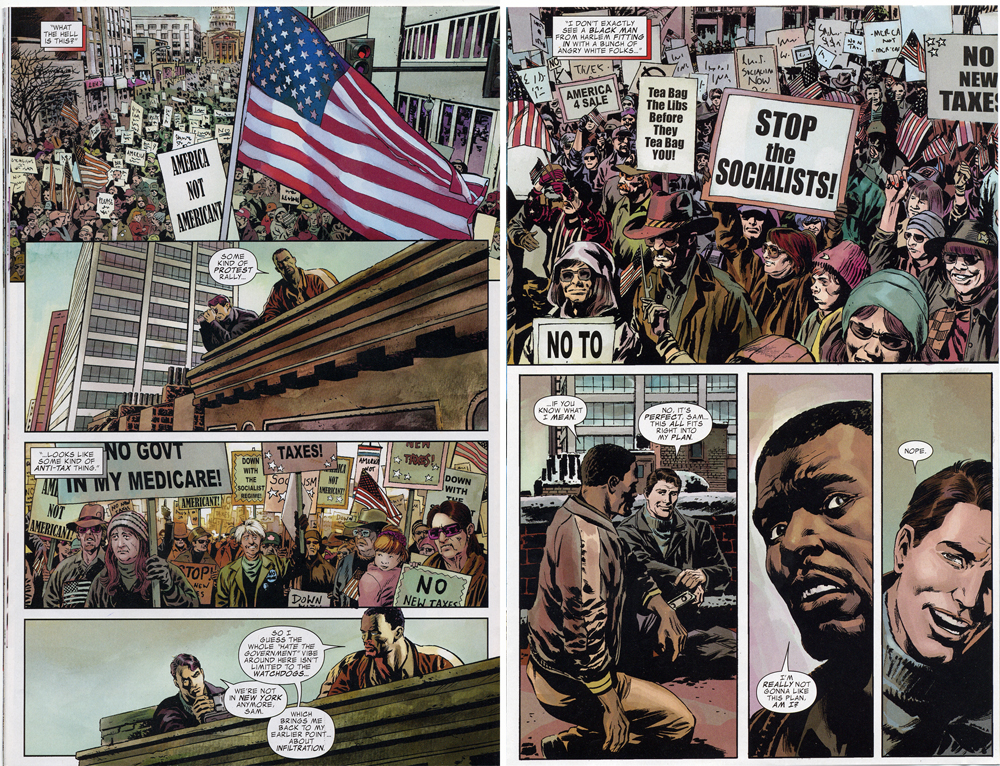
Since 1941, Captain America has been one of the most popular comic book characters around. The fictional super-patriot fought Nazis during World War II, took on those who burned the American flag during the Vietnam era, and raked in hundreds of millions of dollars for Marvel Comics along the way. Now, the appearance that he is taking on the Tea Party Movement in a storyline about investigating white supremacists has forced Marvel to apologize for the comic hero.
The Yahoo article also includes the relevant pages from issue 602 of Captain America:

I am of somewhat mixed feelings about the whole “controversy”, if indeed it is one. On one hand, I probably wouldn’t be thrilled if a right-winger wrote a comic caricaturing liberals as fanatical communists (though I wouldn’t be whining about it), on the other hand in my opinion the strip doesn’t depict anything that isn’t spot on. I’m sorry to see that Marvel felt like they had to apologize for an artistic decision by a writer, though I can somewhat understand that they are an entertainment business that doesn’t want to alienate any customers.
One thing I’d like to point out, though, is that the Captain America comic has a long history of addressing social issues. This isn’t the first time that its writers have used the book and the character as a mirror to show its readers some of the unpleasant traits of America.
Mythbusters were scooped — by 130 years! (Finger in the barrel)
During my first evening in San Antonio, I sequestered myself in my hotel room to polish up my presentation. Fortunately, there was a Mythbusters marathon on the Discovery Channel at that time, so I was able to keep myself marginally sane by watching the ‘Busters abuse places, things, and themselves for the cause of science.
One of the episodes that played during the marathon contained the “finger in the barrel” myth — the idea that a person can stick a finger in the barrel of a rifle or shotgun as it fires, causing the barrel to split like a banana peel without harm to the finger! The initial investigation of the ‘busters clearly demonstrated that a finger would certainly be lost in the attempt, and that a barrel would not split in the manner suggested. An updated investigation two years later, however, demonstrated that a rifle barrel could be split if sufficiently weakened by use.
In a remarkable case of serendipity, the next evening I was browsing the Proceedings of the Royal Society of Edinburgh and came across an article with the title, “On the bursting of firearms when the muzzle is closed by snow, earth, grease, &c.”! The article, by Professor George Forbes, is a theoretical explanation of the bursting of firearms and was published in the 1878-1879 session of the Royal Society, meaning that Forbes’ investigation was some 130 years before the Mythbusters! The calculation and explanation are short and entertaining, and I thought it would be fun to take a look at them.
Happy birthday to Bill Nighy!
Even as busy as I am, I can't resist taking a moment to wish happy birthday to one of the coolest actors out there, in my humble opinion: Bill Nighy!…
Richard Garriott on Ultima V
(I'm still working hard on my book! I'll throw a few posts out here and there as I find the time.) As a follow-up to my post on "videogames as…
Video games as art: My favorite games that are more than just ‘point and shoot’
The other night, I stayed up way past my bedtime playing the finale of the video game DragonAge: Origins, the recently released fantasy role-playing game (RPG) by BioWare. Though the game had a lot of technical limitations that drove me nuts, and the fantasy setting was definitely stereotypical (Zero Punctuation had a great review of the game), in the end the characters and the development of the story won me over. The game is designed to force you to make very hard decisions, most of which possess no right answer. Though I made the choices that I felt were right in the game, I was genuinely saddened at the end of the game because of the consequences of those choices. It may seem odd, but it is a game that will probably stick with me for some time.
This reminded me of a topic I’ve thinking of blogging about for some time: are video games artistic? Of course, modern video games have armies of artists producing the graphics and the music, and there are other sites that consider video games as art in a more abstract sense, but I’m really thinking more about the stories that are told and the way they are told.
Roger Ebert has, in years past, caught a lot of flak for expressing his opinion that video games cannot be art comparable to great literature and movies:
…I did indeed consider video games inherently inferior to film and literature. There is a structural reason for that: Video games by their nature require player choices, which is the opposite of the strategy of serious film and literature, which requires authorial control.
I am prepared to believe that video games can be elegant, subtle, sophisticated, challenging and visually wonderful. But I believe the nature of the medium prevents it from moving beyond craftsmanship to the stature of art. To my knowledge, no one in or out of the field has ever been able to cite a game worthy of comparison with the great dramatists, poets, filmmakers, novelists and composers. That a game can aspire to artistic importance as a visual experience, I accept. But for most gamers, video games represent a loss of those precious hours we have available to make ourselves more cultured, civilized and empathetic.
Roger Ebert has given this a lot of thought (and gotten into arguments with Clive Barker over it), and he makes a very reasoned case. If I understand it correctly, he argues that good movies and literature require the author to tell a story the way he or she wants to tell it — the more one gives the player control over the outcome of the story, the more one is sacrificing their story and artistic vision.
I used to think more or less the same thing as Ebert, but these days I respectfully disagree with him. Firstly, interactivity doesn’t necessarily ruin the story the author wants to tell — it can place the gamer into the story in a way that gets them more involved than a passive reading can do. Furthermore, it is possible to use the very act of interactivity to tell a sort of ‘meta-story’ — showing the gamer how their actions have consequences and showing how those consequences can ripple further along the line in the tale.
Of course, most games don’t do this at all, and I can’t blame Ebert for not being familiar with some of the gems of the genre. Heck, most movies that are produced fall very, very short of being ‘high art’, and someone who casually follows the summer blockbusters would certainly get the impression that movies are shallow and vapid.
With this in mind, I thought I’d share my list of video games that aspire to something more than shallow entertainment. Whether or not they reach the level of ‘art’ I leave it to the reader to decide. Certainly this isn’t intended to be the final word or even a convincing argument in favor; the internet is filled with commentary on the subject.
(more…)
Horror writers on horror films, from Focus Features
A few days ago, I got a nice email from FilminFocus.com, the film culture website of film company Focus Features (A Serious Man, Brokeback Mountain, Coraline). For Halloween, they asked five horror writers to each list their five favorite horror movies. Some of the names I’m familiar with — Kim Newman, Joe R. Lansdale, Tananarive Due — and others are new to me, but their choices are all interesting, even though there are some that I wouldn’t necessarily agree with (Carnival of Souls? Really?).
Though I’m not a professional horror author (yet), I thought I’d chime in with my own set of movies that disturb me! This list is by no means complete — after all, it’s only five — but it is indicative of what unsettles me…
The movie 2012… stoopid before it even comes out
You know, I'm not in principle against a film based on the premise that the world will end in 2012 as prophesized by the ancient Mayans, even though the idea…
The Linkin’ Log, video edition: October 8, 2009
Over the past couple of weeks, a few videos caught my eye, for various reasons. I thought that it was a good time for a collection of links: Via Steven…
Happy birthday to Mark Hamill!
Today "marks" Hamill's 58th birthday! People are most familiar with Hamill's star-making role as Luke Skywalker in the original Star Wars trilogy, which I still remember seeing in the theaters…